Welcome to week 163 of the Tuesday Photo Challenge!
After a week of wonderful Tower posts, I thought it might be nice to take a step back into time. The theme of this week is inspired by our vacation in Ireland, as in many locations one felt the gentle tug of days gone by, telling of a time that was very different. With that in mind, your challenge is to portray that which connects you to all things Ancient. As usual, there are many ways to approach the Ancient (I’ll even take Ancient Aliens!), so I’m sure that your creative minds will come up with something interesting!
Have some fun with this theme and don’t let the dust of the ancient settle on you!
This is one of the images that inspired this theme…
This view looks into the Oratory of the Innisfallen Monastery, which sits on Innisfallen Island in Loch Leane. We reached it by small boat, which allowed us time on the island to explore the old abbey and this oratory. The abbey on the island dates to the 7th century with the current visible structures ranging from the 10th to 13th century. This oratory hails from the 12th century.
What struck me about this view is that I could feel the past pulling me back in, which gave me a sense of what it was like to sit in quiet contemplation in this small chapel hundreds of years ago…
The full rules of this challenge are in TPC Guidelines, but here’s the tl;dr:
Create a pingback link to this post, so that I can create a post showing all of the submissions over the week (note: pingbacks may not appear immediately, as my site is set up to require approval for linking to it; helps against previous bad experiences with spamming)
Have fun creating something new (or sharing something old)!!
Do the ancients proud and come up with a novel entry!
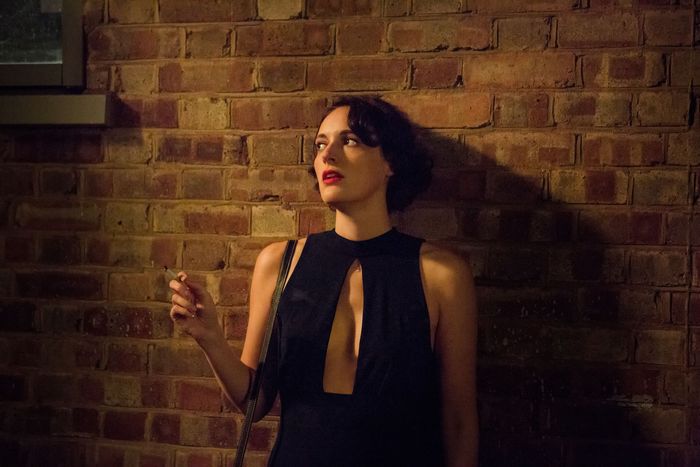
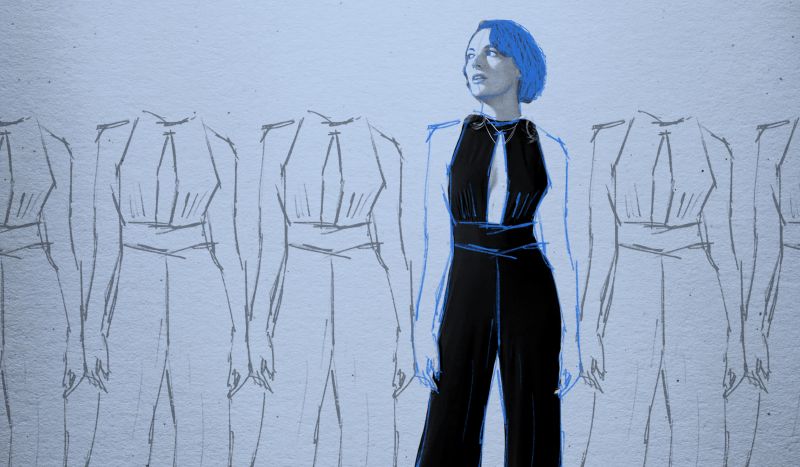
This is a love story. A dangerously elegant woman (noble stock) in lips the color of a dying rose (not a lipstick, but a blend of oils, waxes, and pigments based on MAC’s Dare You), hair a roaring bob, a cigarette perched on her Erté fingers, stands pensively against a brick wall (real?), the burnished light (not real?) casting the kind of shadow that fills in the blanks — and the cleavage. This is Fleabag (of the Amazon series of the same name, written by and starring Phoebe Waller-Bridge), taking a breather behind a restaurant during a fraught family dinner, a fourth-wall-demolishing millennial café owner who could pass for a femme fatale in a film noir. A big part of that latter fantasy is the navy blue jumpsuit she’s wearing (Love, $50), or, more accurately, embodying. The keyhole at the front is more like a door ajar, two strips of material like curtains begging to be parted while threatening to close. Her shoulders jut out, her back is exposed — this is as naked as chic is allowed to be. It is a sleeveless, backless, armless, chestless (well, sort of) number that requires legs for days. To wear it the way Fleabag does, you basically need to be Fleabag, which means you basically need to be Waller-Bridge, whose androgyny (she dressed as a boy when she was a kid), sexiness (she dressed what we think of as the opposite of a boy when she discovered them), and sylphlike stature are as impossible to mimic as the rest of her.
When everyone ran out to buy that jumpsuit last week, that is what they wanted: everything it entailed, from the lights illuminating the scene right down to the It Girl inside. In her ode to the jumpsuit, The Cut’s Kathryn VanArendonk — who bought two sizes just to be sure — wrote not so much about how it looked as what it meant: “It’s revealing in a way that feels like a choice rather than a plea.” A British fan then polled Twitter: “Will buying the Fleabag jumpsuit solve my emotional problems AS WELL as making me look bomb?” The only answers she provided were “Yes” and “Absolutely.”
“I think people don’t always view contemporary costuming as hard, and it’s really hard,” says Emma Fraser, creator of theTV Ate My Wardrobe blog. “It’s not just about throwing together an outfit,” she explains, it’s using clothes as “an extension of who that character is.” The last time a television star’s style migrated en masse into off-screen culture may have been The Rachel in the ’90s: the shaggy hairdon’t of the Friends’ everywoman played by Jennifer Aniston, whose face was normal enough that every woman thought a mere haircut could be a conduit for a New York City life that didn’t suck. Fleabag gives us an updated version of that same generational aspiration — the bold red lip, the navy jumpsuit, the “achievable” look and life. Describing the character’s allure, Fraser inadvertently defines the millennial: “Everything can be a mess, but you can still kind of be put together.” Watching television can be like window-shopping, shallow characters being little more than clothes horses for pricey brands, so seeing a layered antiheroine whose affordable accoutrements are inseparable from who she is feels revolutionary. And who, these days, doesn’t want to be part of a revolution? As Waller-Bridge herself texted Fleabag costume designer, Ray Holman, (referencing Twitter): “The jumpsuit is a movement.”
* * *
Broadchurch brought Waller-Bridge and Holman together five years ago — she was acting on the series, he was doing costume design. He was too busy to work on the first season of Fleabag so Jo Thompson designed that one, but when Thompson was too busy during the second season, Holman stepped in. He read the script first, of course, because he always does that before accepting a project. And despite only having one episode’s worth of material, he took the job. “Oh my god,” he recalls Waller-Bridge telling him, “I did a little dance in the office when you said yes.” Holman had a limited BBC budget (he wouldn’t reveal it, but they reportedly spend around $1 million total per episode, pocket change next to Game of Thrones’ $15 million) and didn’t want anything to stand out (oops). Holman purchased a handful of jumpsuits, wide-leg jeans, striped shirts, and canvas shoes — all items he had discussed with Waller-Bridge — for around 12 outfits total. None of it was expensive: Fleabag runs a cafe in London, remember. “She is stylish but completely High Street,” Holman tells me. “It’s quite a generic urban look, really. It’s quite practical, but slightly stylish.” One of his secrets, he says, was dressing Fleabag according to her situation, rather than just her personal style. The flashback to her mother’s funeral was the hardest because it balanced two opposing ideas: Fleabag’s grief, and, more largely, the objectification of women even in their grief. In that scene, Fleabag appears in head-to-toe black, wearing a blouse that would not look out of place in a courtroom.
As much as the first season of Fleabag is about loss, the second is about love. And isn’t it like that messy bitch to fall for the one guy she can’t have sex with. When we first meet the priest (aka “the hot priest,” played by Sherlock’s Andrew Scott), it’s not clear he is one. He’s unknown to Fleabag, just a random sweary guy at the table of her family dinner. He’s not wearing the dog collar (the audience shouldn’t have any preconceived notions, says Holman). Instead, he is rumpled, in a lavender linen shirt designed by Oliver Spencer, master of the relaxed Brit look (as if that isn’t an oxymoron). Father looks good, but not too good. “He’s quite poor,” the costume designer explains. “He’s not a rich Catholic priest so he doesn’t have many clothes and the clothes he has, they’re old.” He’s not the point anyway. This episode belongs to Fleabag. Fleabag and her jumpsuit (and, okay, her priest boner).
“It could be a disaster, it could be absolutely brilliant” is what Holman thought when he first saw the jumpsuit in the basement of the Oxford Street Topshop in London. It was designed by a small local label, Love, which was founded by Teri Sallas and her husband, Toby, in 2003. “I wanted to make something that covered everything up but was still sexy,” Teri toldThe Guardian. Though the jumpsuit has been identified everywhere as black in color, Holman insists that he bought two versions – one black, one navy – and that the one on screen is blue (he just never corrected anyone, not to mention that Love, according to Toby, hasn’t produced that version “for some time.”) Holman hesitated because he knew a bra couldn’t be worn under it, but that’s also part of its charm — the apostatism of wearing such a thing to a family gathering. Fleabag’s slightly profane clothing choices, by the way, are deliberate. It’s part of her “off-key” character, which is why we find her in a too-short red dress at her dad’s wedding (that one sold out in the U.K. too) and this too-dressy jumpsuit (paired with sneakers). Maybe she hasn’t seen her family for ages and she’s trying a little too hard. Or maybe Waller-Bridge just put on the jumpsuit and fell in love with it. Holman says that when she wore it for the first time, it was a “wow moment” for them both. Waller-Bridge had two words for it: episode one.
The first episode of the second season has Fleabag at a fancy restaurant celebrating her parents’ engagement. Her family hasn’t been together like this in more than a year, since everything blew up between them over various mishaps, a number of them starring Fleabag. This jumpsuit is her, grown-up — elegant, but, still, showing some tit. The struggle within (and without) her continues, but on a more subdued level. At the table she is wry and ramrod straight, her sideboob teasing the holy father beside her. Smoking behind the restaurant, alone, in the dark, the glow of the street lamp bringing out her curves, she is introspectively sultry. “You look strong,” her dad says. And when she and the other father end up back there alone for the first time, instead of asking for his blessing, she keeps her sins to herself. “Fuck you,” the priest calls to her naked back. It’s a Fleabag kind of benediction.
The second season of Fleabag originally aired on the BBC in March, but British siteStylist didn’t track down the jumpsuit until about two months ago, at which point it sold out. Since the show’s Amazon premiere on May 17, American viewers have been similarly clambering to buy it. Holman was “completely surprised” by the response and bemused by the “jumpsuit as movement,” but thinks it’s great they helped a local indie label boost its sales. Fraser, who is also British, is witnessing the cycle for the second time and offers some prosaic reasons for the transatlantic phenomenon, including availability (shot in advance, shows often come out when the clothes are no longer available) and affordability. Not to mention practicality — per VanArendonk, the jumpsuit “could so easily pass for something much more expensive, but which I can put on without fretting about stains, child smudges, wrinkles, weird crotch lines, or much at all in the way of further styling” — as long as you have a body that approximates Waller-Bridge’s. Fraser provides the contrasting example of Killing Eve (another series developed by Waller-Bridge), with its aspirational “outlandish” costuming, particularly Villanelle’s translucent bubble gum pink pouffe-frock from the first season. “Nobody could afford that Molly Goddard dress,” she says, “and where would you wear that?”
But the jumpsuit is more about the story of Fleabag, which it serves to represent. This is the story of a young woman who looks like she has it together but doesn’t, and if you get just close enough, you can see it. This is a woman who knows who she is, but still feels the need to perform, who is constantly wrestling with the push and pull of revealing too much and too little. And in the perfect chiaroscuro, this is a woman who thrives on the frisson of impossible love. But it’s also about the story of Phoebe Waller-Bridge, the It Girl whose singularity, which is what everyone keeps trying to imitate, is It precisely because of its indivisibility from her. This is a woman who can be easily conflated with the character she created from elements of her own life. WhenSlate asks why so many journalists want the jumpsuit, the answer is obvious: because they want to create an award-winning one-woman play (Fleabag) in their 20s, because they want to helm two series (Crashing, Fleabag) by the time they are 30 (and then a third, Killing Eve), because they want to be hired to appear in a Star Wars film and to brush up Bond. If they can’t have Waller-Bridge’s career, at least they can have her clothes.
* * *
The Fleabag jumpsuit actually appeared on the red carpet (the black version, anyway) a full six months before it appeared on the show, but no one remembers that. Waller-Bridge wore it, along with a huge grin, up-swept hair, and patent leather flats to a screening of Killing Eve in September. In that context, without a cigarette, without her flapper do, without the brick wall or the glowing light or the cleavage or the priest, the jumpsuit lost its mystique. In those photos it has reverted back to a, well, black jumpsuit. The same thing happened each time someone posted a photo of themselves in it. Even when it suited them, which was often, it didn’t have the same power without Fleabag’s context. And the more people bought it, the less impact it had. Like the sparkly white dress in Cinderella, the sleek black jumpsuit dissolved in the daylight.
The irony is that these writers would have been better off, you know, writing. Because that’s what they really want — to be this famous writer, to be who she is and what she creates. Of course, that costs a lot more than $50. A jumpsuit is a tangible symbol of the life these women want and the fallacy, as understandable as it is in a culture that silences women as well as writers — why am I doing this, again? — is buying a well-cut piece of dark material as a shortcut to that life. Fraser was actually one of the few women writers who resisted the jumpsuit’s siren song, but it was a close encounter. She was about to buy it before remembering who she was: a woman who had other jumpsuits, and who also needed to wear a bra. A woman who did not have a production company turning her body into a genre, who wasn’t living a fictional romance with a man of God, who didn’t live a real life in which she herself was an idol (well, by Hollywood standards). “I had it in my basket,” Fraser says, and then she asked herself a question that, ironically, is very Fleabag: “What are you doing?”
NBA players are the best paid athletes in sports — making tens of millions and sometimes hundreds of millions of dollars over a single contract. Heck, the league average salary is $10 million per season. But all that scratch won’t last a lifetime if you don’t manage it well. At the New York Times, Devin Gordon profiles Joe McLean, a guy who almost made the NBA and has since made his living offering white glove concierge services and financial counseling to some of the wealthiest players on the court.
Mr. McLean doesn’t negotiate his clients’ deals — he’s not an agent. His job is to grow every dollar that comes in and track every dollar that goes out. He’s part investor, part butler, a C.F.O. and a golf buddy, a sports therapist and, when necessary, the disapproving dad. When the explosive power forward Aaron Gordon got his first big contract last summer ($84 million), Mr. McLean warned him that “with great abundance comes great discipline.”
Last summer, after Mr. Gordon signed his $84 million deal, he bought a house and was immediately confronted with all kinds of mundane homeowner questions for which he had no answers. Such as: How much should it cost to mow my lawn?
“The first couple people that came to the property were sending these invoices trying to charge $4,000 to $5,000 a week to cut grass and do some power washing,” Mr. McLean said. Mr. Gordon has a big house, but not that big — it should have cost around $500. “So I’ve got to go back to Orlando and get people that we trust on the property. I’ve got to speak to everyone that goes near it, because they’re all signing N.D.A.s.
The youthful years did not stop.
I continued with a desperate affair or accepting the face of the truth and the courage to leave, that it was all my fault for me.
Photo: Ben Tenesion
Recalling the old concept when I and she loved each other very deeply, but now she has found another person better than me, today I accidentally found the picture when I was old and she took the time to make an appointment I met her on the Sydney Harbor Bridge, Australia and my feelings rushed back to me to miss her my deepest first love but all are just the past, I wish you happiness with that person!
Chiều qua 22/6, anh nghẹo Nguyễn Xuân Phúc đã ngồi đàm đạo trực với ông Lý Hiển Long tại Bangkok, Thái Lan về vụ ông Long viết trên facebook và phát biểu của mình. Trên quan điểm bảo tồn và thể diện của đảng anh nghẹo đã cực lực phản đối hành động không đáng có ngày 31/5/2019 của ông Lý Hiển Long phần liên quan đến Việt Nam và Campuchia giai đoạn 1979-1980. Anh nghẹo rất cứng rắn, tiện thể dằn mặt luôn nếu ông Long còn vi phạm lần nữa Việt Nam sẽ cấm xuất cảnh công dân đặc biệt công dân nữ theo hình thức XKLĐ tại phố đèn đỏ của Singapore. Qua buổi đàm đạo, thấy sự cứng rắn hù dọa của anh nghẹo nên ông Long đã phải nhún nhường một cách khéo léo rằng là quân đội Việt Nam chỉ sang Campuchia với mưu đồ xâm chiếm chứ không phải xâm lược. Nghe đến đây, anh nghẹo rất phấn khởi bởi những vùng mà quân đội Việt Nam chiếm đóng thời gian đó toàn do bọn Khmer Đỏ, Pol Pot trú ẩn. Ông Lý Hiển Long cũng giải thích Singapore không có ý làm tổn thương Việt Nam, chỉ nhắc lại một chương đau buồn trong lịch sử Đông Dương để nhấn mạnh hoà bình, ổn định và thịnh vượng hôm nay không mặc nhiên mà có, và bối cảnh hiện nay. Ông Lý Hiển Long cũng nhấn mạnh, Singapore hết sức coi trọng quan hệ hữu nghị và tin cậy với Việt Nam, đánh giá cao vai trò và những đóng góp quan trọng của Việt Nam từ trước tới nay trong việc XKLĐ tại phố đèn đỏ cho Singapore. P/s: theo một nguồn tin thân cận, xong buổi hội đàm đi ra ngoài cửa, ông Long lẩm nhẩm rằng “ĐM nói tinh vừa thôi, bố mày lệnh cho rút hết các KCN, KCNC về nước cho bốc cứt ăn trừ”. Tin từ Bangkok, tại Phố Sà Cọt Căng lôn va khon, Soi 13.
بعد كل أيام العمل الشاقة ، أراد الجميع مكانًا للاسترخاء والراحة ، لذلك اخترت مكانًا مثاليًا لأداء الشارع الذي كان فو كوك.
صورة فوتوغرافية: Ben Tenesion
أتذكر أيام الاسترخاء في Phu Quoc ، ذهبت لزيارة العديد من الأماكن ، ولكن المكان الذي لدي فيه أكثر شيئ هو Bai Khem ، مع البحر الأزرق الصافي والرمال البيضاء النقية والمناطق المحيطة الجميلة للغاية. المناخ المعتدل والبارد يجعلني أهدئ رأيي بطريقة لطيفة ، والمخاوف ، والألم ، والإرهاق يعلم الجميع.





 Ben Tenesion